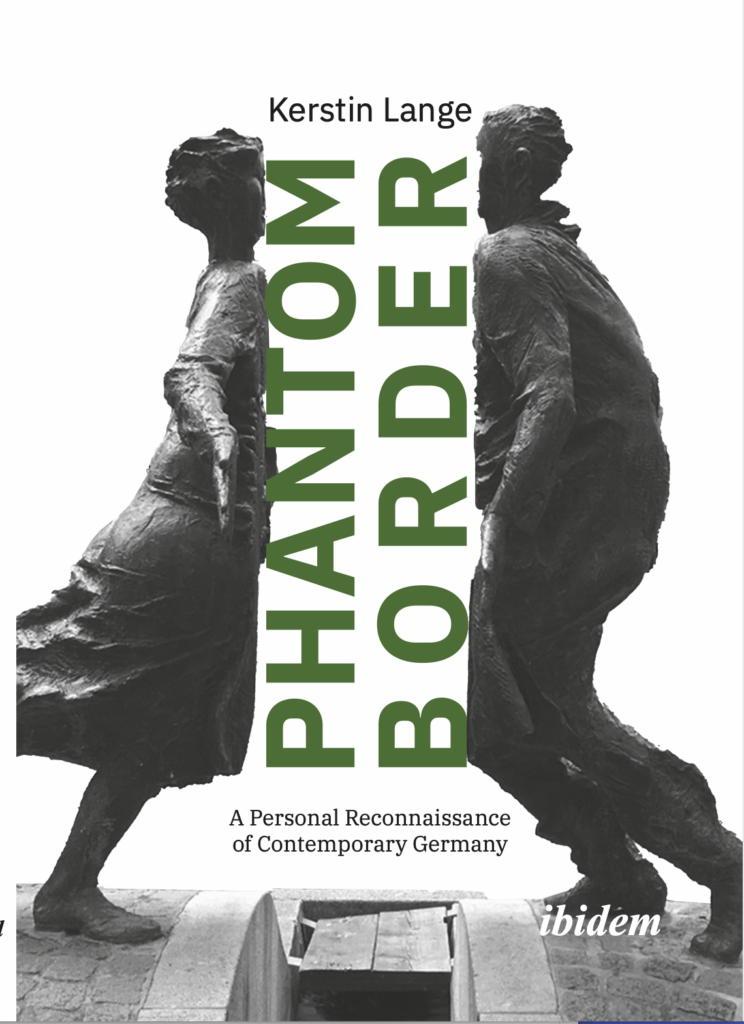
…by The Revelator, the online magazine of the Center for Biological Diversity. “Regular readers may remember Lange’s Revelator essay about Germany’s “Green Belt” and what it represents for humans and nature. That essay just scratched the surface — this book-length examination takes us on a powerful journey through the Green Belt’s history, culture, and ecology.
“During the four decades the Iron Curtain divided Germany and the European continent, over 1,200 rare animal and plant species found refuge in the border strip — today’s Grünes Band or Green Belt. Lange uses the 1,400-kilometer-long German Green Belt as a map for a personal reconnaissance of her home country and as a prism through which to investigate the transformation of the border, along with the societal reverberations of the division and its aftermath.”
Phantom Border can be ordered at any bookstore and is available at Columbia University Press as a paperback and Ibidem Press (paperback and E-book).









I couldn’t stop reading. When I finished, I was ready to have a look myself at the remains of the Phantom Border. The Iron Curtain, the border dividing Germany after 2nd WW into East and West Germany,
was extremely fortified by the East German Government from early 1960 to hinder East Germans fleeing to the West. Especially Lange’s empathetic interviews with concerned individuals along the some 800 miles long border touched me thorougly. Although I had heard and read about the inhumanity, separated families, political indoctrination, torturing and killing over decades before, this book made me shiver. But the author found a balance between evil and good by conveying the very positive result that Nature flourished in the Death Zone. Is that the Phantom? Possibly. Now as a native to Germany, I want to see the miracle myself which came to light after the Berlin Wall came down end of 1989 and thereby all fortifications.
Very good Read!
Thank you so much for your comments Heiner!
“Having been raised in Germany and having lived in the USA for more than 30 years now, Kerstin Lange is uniquely qualified to write a book that addresses questions of migration, identity, and belonging–all highly-relevant topics for everyone in today’s world. In addition to drawing from her own rich life experiences, work, and studies in Germany, Vermont, and Kenya, Kerstin has woven her deep knowledge and profound insights gained from Anthropology and Natural History/Ecology into this fascinating exploration of how the former highly militarized German borderland has gradually been transformed into the “Green Belt” where rare plant and animal species are now thriving. In making this amazing journey by bicycle and on foot, she has reached out to so many people along the way and shared their voices and perspectives on how the events, history, culture, ecology, landscape and humanity have shaped their lives. There is much for all of us to learn in these challenging times from the personal journey she shares in this eloquent book!”
Thank you for reading my book and for sharing your thoughts!
“Phantom Borders” is a very interesting book. The very personal style in which the book is written distinguishes this book clearly from the other “traveling diaries along the former innergerman border”. Reading the chapters, the feelings appears to be with the author and the talking persons at their kitchen table or at a their bank in front of the house. The testimonies clearly show that also nearly 35 years after the reunification, that the GDR still is present and personal consequences, suffering, limitations are not forgotten.
Working on the topic within the preliminary world heritage office green belt of Germany, I can confirm this every day. As well the importance of not forgetting, of remembering and of learning from the past – every day.
Therefore, the book is very welcome as a collection of personal testimonies, and to bringing the topic to an international audience. Even if publications about the Green Belt, the former inner German border, are not rare, most of the publications are in German and therefore unaccessible for too many persons. Further testimonial collections also from people in Eastern European countries, where the people have also suffered from the iron curtain, would be welcome.
Thank you for this eloquent book!
Thank you for your eloquent comments, and for reading Phantom Border! I look forward to hearing more about your work next time our paths cross.